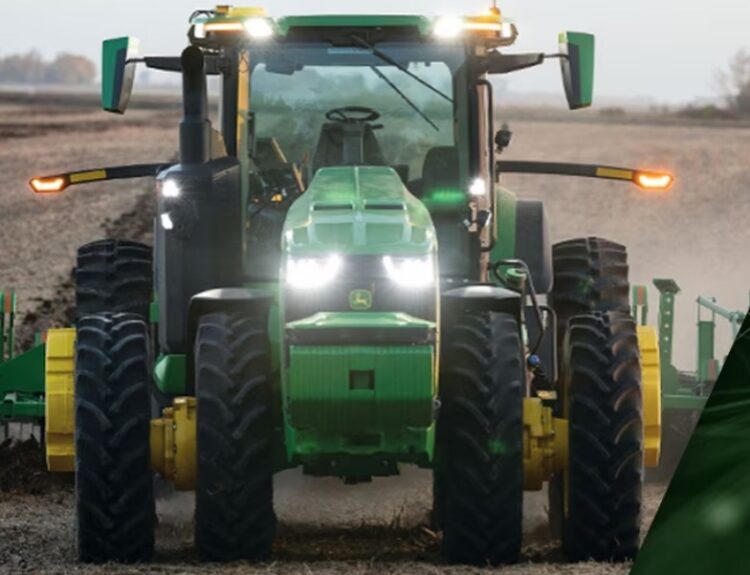


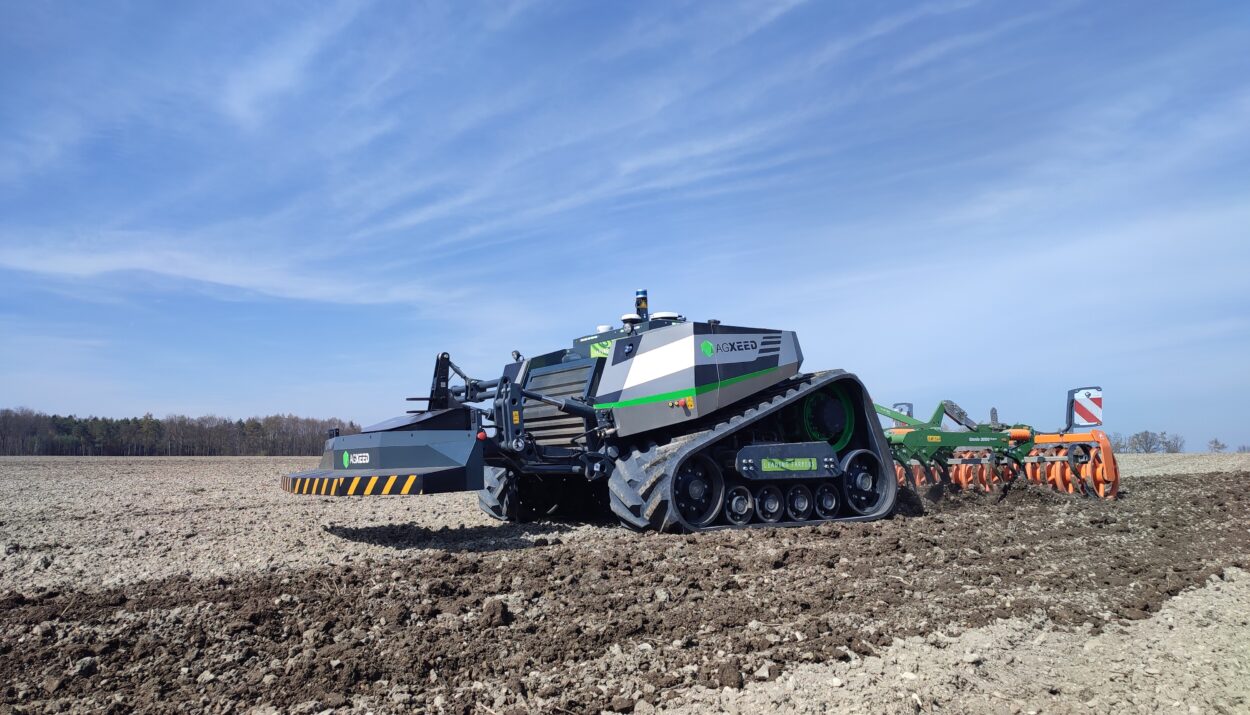
AgXeed is making significant strides. Two major agricultural machinery manufacturers, Claas and Amazone, have invested in this small startup. One of the robots, model AgBot 5.115T2, is operating on a farm in Hungary.
AGXeed and Its AgBots
Established in 2018, AGXeed aims to liberate farmers from endless hours spent in tractor cabins while lightening the burden on soil from the increasing weight of modern tractors. By winter 2019, the first functional prototype was in operation, gathering field experience. Two years of testing and improvement followed, and since 2022, AGXeed machines have been commercially available. The portfolio includes three models: the AgBot 2.055W3 for orchards and vineyards, the AgBot 2.055W4 for seeding and hoeing, and the AgBot 5.115T2 designed for fieldwork.
Field Robot in Action
The AgBot 5.115T2, specifically, operates on a farm near Siófok, Hungary, owned and operated by a Hungarian-Dutch company managing 3800 hectares of agricultural land. Specializing solely in crop production, the farm allocates 30% of its land to wheat and barley, another 30% to rapeseed and sunflower, and the remaining 30% to corn.
The farm comprises several centers, with mostly flat terrain but some hilly areas. Field sizes vary, with the largest being 250 hectares and the smallest 1 hectare. Equipped with modern agricultural machinery dominated by medium-sized and larger tractors from Fendt and John Deere, the farm handles its own harvesting, managed by Claas harvesters.
The latest addition to its fleet, the AgBot 5.115T2, currently operates on one of the farm’s centers, covering 400 hectares without needing to cross public roads. Its primary task is soil cultivation, working in tandem with a disc harrow, replacing a tractor with up to 300 horsepower. While there are no immediate plans to undertake more sophisticated tasks with the robot, the farm intends to experiment with additional applications. For instance, they’re considering integrating it with a fertilizer spreader in spring.
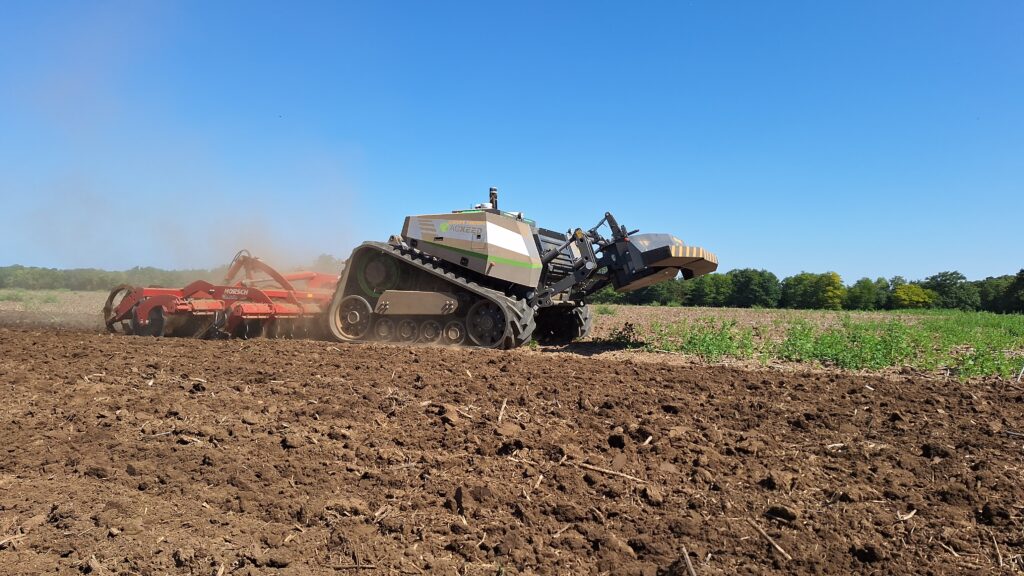
AgBot 5.115 T2
Behind the alphanumeric jumble of AgBot 5.115T2 lies an autonomous field robot poised to eventually replace a medium-powered tractor fully. Presently, it can navigate fields independently and perform tasks typically handled by conventional tractors. Despite its compact design, the machine is powerful enough for demanding tasks. It features a track chassis with adjustable track width ranging from 1800 to 3200 mm and a ground clearance of 420 mm. Tracks are available in various widths from 300 to 910 mm. The machine stands at 1800 mm in height and 3600 mm in length with an accessory. Its weight, excluding attachments, is 7.8 tons.
Powered by diesel-electric, coupled with tracks, the AgBot ensures high efficiency, minimal soil compaction, and excellent maneuverability. Under the hood is a 4.1-liter Deutz diesel engine compliant with Stage V emission standards, providing a maximum output of 156 horsepower and a peak torque of 610 Nm. The electric drive system propels the machine within a speed range of 0-13.5 km/h.
Optional features include an electrically driven power take-off with independent speed control, front and rear three-point hitches for compatibility with standard implements, and the ability to power attachments via a power take-off, hydraulic circuits, or high-voltage electrical connection at 700V.
The AgBot 5.115T2 can be equipped with a hydraulic load-sensing system delivering up to 85 l/min and featuring up to four double-acting proportional valves. It can lift up to 8 tons at the rear and 3 tons at the front.
Technical Specifications
- Track chassis with adjustable width (1800 to 3200 mm) and ground clearance of 420 mm
- Track widths available from 300 to 910 mm
- Overall height: 1800 mm, overall length with accessory: 3600 mm
- Weight (without attachments): 7.8 tons
- Diesel-electric powertrain with a Deutz diesel engine (4.1-liter displacement) compliant with Stage V emissions standards
- Maximum output: 156 horsepower, maximum torque: 610 Nm
- Electric drive system enabling speeds ranging from 0 to 13.5 km/h
- Optional electrically driven power take-off with independent speed control
- Front and rear three-point hitches for attachment compatibility
- Hydraulic load-sensing system with a flow rate of up to 85 l/min
- Up to four double-acting proportional valves
- Rear hitch capacity: 8 tons, front hitch capacity: 3 tons
- Redundant integrated autopilot system using RTK signals for precise navigation
- Safety features including a geofence system, visual indicators, audible alarm, emergency stop buttons, LIDAR, ultrasonic, and radar sensors
- Optional features such as Isobus IBBC sockets and a 700V socket for electrically driven implements
Navigation
The machine navigates through fields using a redundant integrated autopilot system utilizing RTK signals, enabling precise operations even at higher speeds. Safety is ensured through a package of safety features and camera surveillance. It can also be operated manually via remote control.
Autonomous operation is facilitated through the AGXeed portal, enabling control over not only a single machine but the entire farm, from operations management to monitoring and evaluation. Robot combinations and accessories can be configured in a virtual warehouse. Once configured, a route can be planned, including turning points, and the entire operation dispatched to the respective AgBot 5.115T2. Remote camera access allows operators to monitor operations.
Safety features include a geofence system preventing the robot from leaving designated areas, visual indicators, an audible alarm, and emergency stop buttons. Sensors such as LIDAR, ultrasonic, and radar integrated into the safety bumper prevent collisions, with the bumper halting the robot upon contact with a mechanical obstacle.
Specific Operations with the Robot
Returning to Hungary, where the AgBot 5.115T2 is operational, thorough mapping of field boundaries and obstacles was necessary before deployment. The operator underwent comprehensive training to familiarize themselves with the robot’s functions and effective utilization. Currently, the robot is employed in cultivating internal areas of the fields, where it can fully leverage its capabilities without human intervention. Its productivity is high, allowing for nighttime operations. Tractors with accessories handle perimeter areas and challenging terrain. The AgBot 5.115T2 is relocated between fields via remote control, but the farm is considering using tractors and trailers for future relocations to other centers.
Currently, the farm’s owner operates the robot, but they plan to hire an operator specializing in robot operation and supervision, particularly as they contemplate acquiring a second robot in the future.
Practical Experience
The AgBot 5.115T2 operating in Hungary, in addition to standard equipment, features various optional specifications such as an electric power take-off with continuous speed control independent of engine speed, four double-acting hydraulic circuits, a Load Sensing hydraulic system, front and rear Isobus IBBC sockets, and a 700V socket for electrically driven implements. The track width was 760 mm, and during a demonstration, it worked with a 4m-wide disc harrow, the Horsch Joker, for the third soil cultivation post-harvest. At maximum depth, it operated at around 6.5 km/h, while at shallower depths, it achieved speeds of 8-9 km/h.
The farm highly praises the AgBot 5.115T2’s work. They appreciate its low fuel consumption, attributed to smoother operations compared to human-operated machinery, and significant reduction in soil compaction compared to large tractors. Given its capacity to replace the work of a 300-horsepower tractor and its operator, the farm management believes that with two AgBots, they could replace one large 600-horsepower tractor.